The original GTA became a hit almost by accident. Now the sequel had one job: prove it wasn’t a fluke. DMA Design’s answer was to bet on the future, and a future with no date on it. GTA II is set in “Anywhere City,” in a year even Rockstar never quite pinned down, and it hit shelves on October 22, 1999, just 23 days after Take-Two announced it had bought the studio behind it. This is the second chapter of our The History of Every GTA series. If you haven’t read the first one yet, start with the story of the original 1997 GTA.
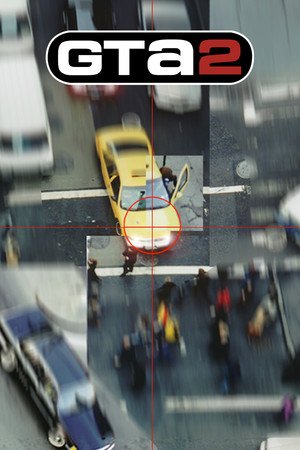
Official Grand Theft Auto II artwork (1999). Image: Rockstar Games / Take-Two Interactive.
A studio caught in a game of musical chairs
By the time GTA II was in the works, DMA Design, the Dundee, Scotland studio founded in 1988, was no longer the independent house behind Lemmings. It belonged to Gremlin Interactive, which in March 1999 was bought by Infogrames (for a reported £24 million). Meanwhile, in the US, Take-Two had spun up a brand-new label in December 1998, Rockstar Games (formally announced on January 22, 1999), built on the assets of BMG Interactive, the publisher of the first GTA, and run by people like Sam and Dan Houser.
The last piece clicked into place on September 29, 1999: Take-Two announced it had bought DMA Design from Infogrames for roughly US$11 million. The game was already nearly finished and hit stores right after.
- 23 days
The time between Take-Two’s announcement of the DMA Design purchase (09/29/1999) and the release of GTA II (10/22/1999).
From “unfortunate project” to the studio’s star
The mood inside DMA changed big time between the first game and its sequel. According to Keith Hamilton, lead programmer on both games, in an interview with Time Extension, the first game’s success flipped the studio’s pecking order upside down:
“It was different now, in that we were no longer the unfortunate project of the company. We were now the big one that everybody wanted to be working on.”
— Keith Hamilton, lead programmer at DMA Design
The credits tell the same story. Jim Woods and David Jones (DMA’s founder) directed, Keith Hamilton stayed on as lead programmer, and Dan Houser, a co-founder of Rockstar Games, handled the writing.
A future with no date
Instead of repeating the first game’s contemporary city, GTA II unfolds in “Anywhere City, USA,” a retro-futuristic metropolis split into three districts: Downtown, Residential and Industrial. It was a deliberate call. According to Colin Macdonald, a former DMA Design developer, in a November 2022 BBC interview (as reported by mxdwn), the team wanted a futuristic setting for more creative freedom with vehicles, weapons and environments. Looking back, he admits the bet didn’t land the way they’d hoped:
“In hindsight, that probably hasn’t resonated with audiences as well as the contemporary vehicles and cities.”
— Colin Macdonald, former DMA Design developer, to the BBC
The franchise seems to have agreed. GTA III (2001) went back to a contemporary city, and the games that followed dove into the recent past, with the 1980s in Vice City and the 1990s in San Andreas. No mainline game has been set in the future since.
Respect, gangs and one boss in common
The big gameplay addition was the respect system. Instead of taking any job that comes along, you now deal with seven criminal organizations, and every choice has a price. Each level offers jobs from three syndicates: two unique to that level and one that shows up in every district, the Zaibatsu Corporation. Doing jobs for a gang raises its respect for you and unlocks harder, better-paying missions. The catch: its rivals start to hate you, and members of gangs with low respect will attack you if you step into their territory.
Besides the Zaibatsu, the other six organizations are the Yakuza, the Rednecks, the Scientists, the Loonies, the Hare Krishnas and the Russian Mafia. Each even has its own radio stations, a soundtrack that GameSpot critic Jeff Gerstmann praised for keeping the station-style feel of the first game.
A movie before the game begins
GTA II opens with a live-action short: about eight minutes, shot in New York City, with a screenplay by Dan Houser and direction by Alex De Rakoff. The protagonist, Claude Speed (played by Scott Maslen), runs jobs around the city for several syndicates until his actions catch up with him. He ends up killed by an assassin from one of the gangs he crossed. And here’s a mystery that still runs today: he may be the same Claude from GTA III. Rockstar has never confirmed or denied it.
Reception: “the same old game,” but still fun
Critics at the time were split. Graphics were the most frequent target: IGN’s Tal Blevins called the visuals “average at best.” GameSpot’s Jeff Gerstmann conceded that “at its core, GTA 2 is the same old game,” but concluded the formula still worked:
“Even though the gameplay is largely the same as in the previous GTA, it’s still a lot of fun.”
— Jeff Gerstmann, GameSpot (1999)
- 1.2 million units shipped to stores
Figure released by Take-Two in October 1999, in launch week, along with expected gross revenue of over US$33 million.
On lifetime sales: we couldn’t find a consolidated, reliable total. The estimates in circulation range from 1.5 to 2 million units, but none comes from a primary source we were able to verify. We chose to publish only what is documented: the launch shipment figure.
GTA II vs GTA I: the numbers side by side
The second game sold faster, but pleased critics less on PC. We only compare what is documented on both sides.
Caveats: GTA I kept selling (roughly 3.5 million units by October 1999 and 6 million by March 2001), but there is no reliable lifetime sales total for GTA II, so there is no fair comparison beyond the first milestone. Scores are averages from the GameRankings aggregator, now offline, and each game had a different number of reviews.
From PC to Dreamcast
Besides PC and PlayStation, GTA II also got a Dreamcast version from Sega, released on May 1, 2000 in North America and May 20 in Europe, and a Game Boy Color adaptation in December of the same year. That last one got bad reviews.
The last mainline 2D chapter and a relic that vanished
GTA II closed out the era when the mainline franchise was a two-dimensional chaos sandbox. Two years later, GTA III would make the leap to 3D and kick off the era the world knows today. But if you want to relive this history by playing, the road got rough. The game vanished from Steam, with no warning and no official explanation, in late July 2025, and the specialist press reported the disappearance in the last week of that month. Rockstar has never explained why, and the game still has no remaster or “definitive” edition for today’s audience.
Trivia and lesser-known facts
- Not even Rockstar pinned down the year the game is set in: the official website at the time said the story happens “three weeks into the future,” another official page pointed to 2013, and the game itself still references the “new millennium.”
- The game’s music was composed by Colin Anderson, Craig Conner, Bert Reid, Stuart Ross and Paul Scargill.
- The Game Boy Color version had a different team: Simon Crisp is credited as director and Anthony Paton as composer.
- The Dundee studio only became Rockstar North in 2002, three years after Take-Two bought DMA Design.
Sources: MobyGames: Grand Theft Auto II credits, Tech Monitor (09/29/1999): Take-Two’s purchase of DMA Design, Take-Two press release of 10/21/1999 (“Rockstar Games Division Begins Global Shipment of GTA2”), GameSpot: Jeff Gerstmann’s review, Time Extension: Keith Hamilton interview, mxdwn (Colin Macdonald’s BBC interview), GTA Boom